
Make AI interview you before it writes anything
The writing assistant technique that works for journalists and PR pros.

Here is a thing I have watched happen, over and over again, since ChatGPT showed up.
A writer has a thing to write. Maybe it’s a feature on an industry shift, maybe it’s a thought leadership op-ed for a client, maybe it is a long Q&A intro. The writer opens ChatGPT or Claude or Gemini, types "Write me a draft of an article about [topic]," and waits. A draft appears. And it’s fine. It’s on topic. It’s the right length and has all the right formatting. But it contains zero of the writer’s actual voice, their human-level observations, or the texture that would make the piece worth reading. The writer either uses it as a starting point and spends an hour beating their own voice back into it, or they close the tab and go back to the blank page.
There’s a way to find the happy balance between AI-assisted and human-written, and it’s one of many techniques I teach in my upcoming course, AI for Media. And it’s conceptually simple: Stop asking AI to write for you. Make it interview you instead.
A MESSAGE FROM ADOBE

The new Adobe productivity agent orchestrates tools and models to generate images, text and rich content like presentations, podcasts and social posts, while also powering conversational PDF editing in Acrobat.
With new PDF Spaces capabilities, users can combine files, links and notes into interactive, shareable spaces for research, collaboration and content creation. VICE News, Kid Cudi and celebrity event planner Mindy Weiss are already using these tools to build trust and deeper engagement with their audiences.
Learn more: Do that with Acrobat: AI-Powered PDF workspaces | Adobe Acrobat
Why ‘write me a draft’ prompts produce mediocre work
When you tell an AI to write you a draft cold, you’re asking it to do the hardest job in the room with the least information. The model has no idea what you actually know about the topic. It does not know your angle, your tension, your reporting, your stakeholder context, your three-word phrase that captures the whole thing. It has no idea what is in your head. So it does what models do when starved for context. It averages. It gives you a safe, competent amalgamation of every article ever written about this kind of topic, and that is, by definition, generic.
Giving it more context can help to a degree. A longer prompt can add persona, audience, structure, examples, tone notes. You can build a 300-word system prompt that approximates the brief you would give a junior writer on your team. That works, sort of. The output gets better. But you have done a lot of typing to get there, and you still have not transferred the most valuable thing in your head, which is the specific observations you made about this specific story or campaign that nobody else would think to mention.
The reason your brief won’t contain that is simple: You do not actually know what you know. Most of what makes a piece distinctive lives in your head as half-formed thoughts, side comments you made to a colleague, a turn of phrase that occurred to you in the shower. You cannot type it into a prompt because you have not surfaced it yet. The blank page is hard not because writing is hard but because thinking is hard. AI cannot help you with thinking by writing the draft for you. It can help you with thinking by asking better questions than the ones you would ask yourself.
Flip the script: make AI interview you

This is the move. Instead of asking the AI to write a draft, ask it to interview you and then assemble an outline from your answers.
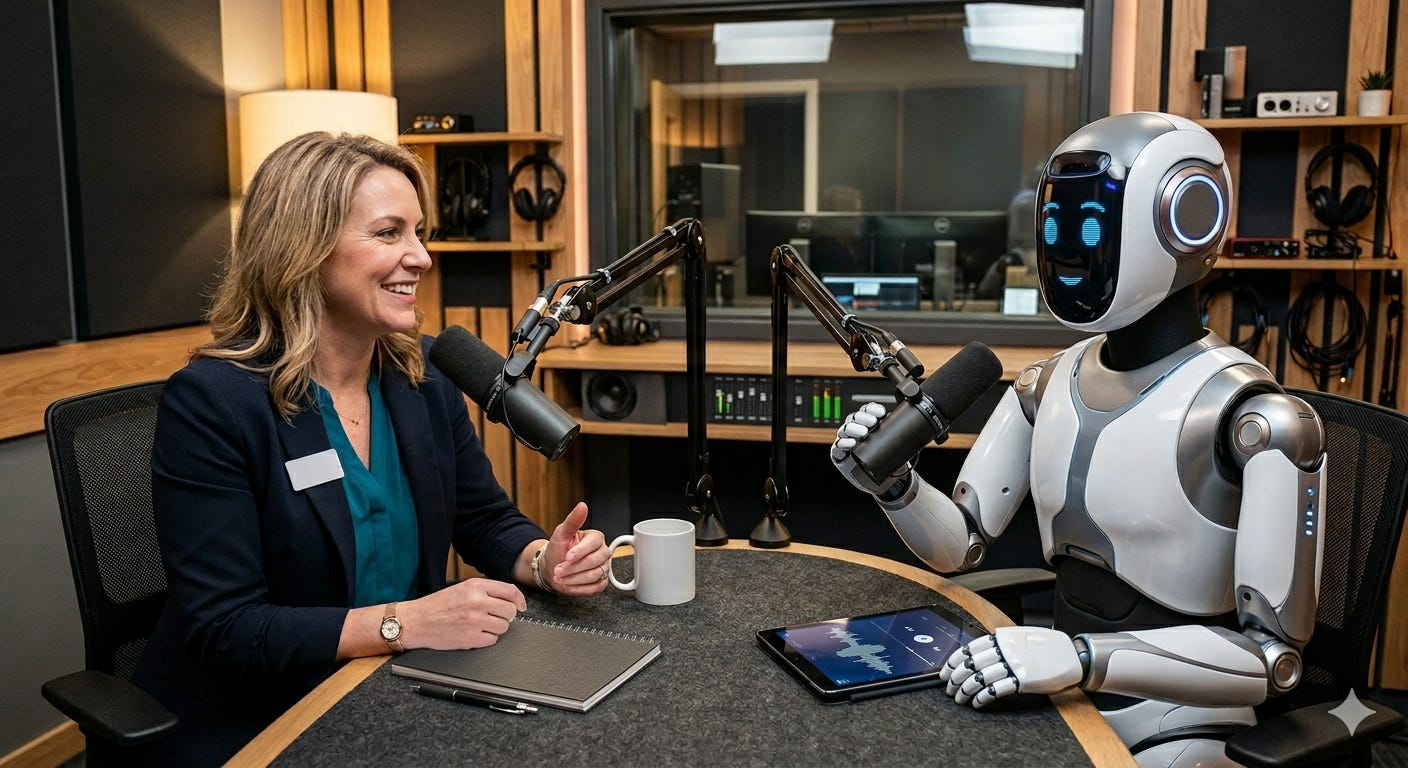
The shift is small in framing and huge in result. You go from being a person who reviews an AI draft to being the source. You sit on the other side of the table from a reporter who happens to know exactly which follow-up question to ask. The AI’s job is no longer to know your topic. Its job is to extract your topic from you. That is something AI is genuinely good at. Language models can ask focused, open-ended questions one at a time, build on the previous answer, and keep digging until you have given it everything useful.
By the end of a five-minute interview, the AI has more usable raw material than you would have given it in any one-shot prompt. Your actual words. Your actual examples. The three things you almost forgot to mention. The piece of context that turned out to be the heart of the story. From there, building an outline or a first draft is a much easier problem, because the model is working with your material, not its training data or whatever it can find on the web.
I have used this approach to write columns, build pitches, sketch feature outlines, prep for podcast interviews, and draft op-eds for clients I was advising. It works on almost any piece of writing that benefits from a distinct voice and original observations, which is to say almost any piece of writing you do as a journalist or a PR pro.
The system prompt that makes it work
You can do this in a regular ChatGPT or Claude conversation, but it works much better as a saved Custom GPT, Claude Project, or Gemini Gem. Once it is saved, you can call it up any time you need to start a new piece without re-typing the instructions.
Here is the system prompt I taught in the course, lightly edited. The two key instructions are reversing the interaction so the AI interviews you, and assembling an outline based on your answers.
You are an inquisitive interviewer. When I give the command "fire away," begin asking me a series of focused, open-ended questions about the topic I am asking about, one at a time. Each question should build on the previous response but also keep me on track. Aim to uncover facts, context, examples, and my personal insights. Keep questions short and specific. When I indicate I am finished by giving the command "all done," stop asking questions.
Once the interview is finished, create a detailed outline for a written piece based on my responses. Include:
1. Working headline, in sentence case, no colon, 60 characters or less.
2. One-sentence hook, a sharp, plainspoken opening that sets up the piece.
3. Main sections, 3 to 6 section headings, each acting like a subhead. Under each heading, provide 2 to 4 bullets that pull heavily from my words. Quote me directly in quotation marks and paraphrase only when helpful. Maintain my original tone, rhythm, and word choice wherever you can.
4. Suggested pull quotes. Choose two strong quotes that reflect my core message or voice.
5. Closing section. Summarize the takeaway. Offer a next step, open question, or a note of tension to close.
6. Research gaps. Call out any areas that need additional data, reporting, or outside sources.
Your goal is to make it easy to turn this outline into a written piece that sounds like me, not you. Be a good editor. Preserve my voice and intent.
A few things worth noticing here. The "fire away" and "all done" commands are not cosmetic. They give the model a clear signal about which mode it is in, which keeps it from drifting back into writing-mode prematurely. The instruction to quote you directly is what makes the output usable as a first draft instead of as a generic outline. The research gaps section is what makes this safe for journalism, because the model is explicitly told to flag what it does not know rather than fill it in with something that sounds plausible.
If you want to push this further, add a layer that captures your voice. A few sentences in the system prompt about how you write, two or three example paragraphs of your past work pasted in, and the model will start mirroring your rhythm and word choice. For most people, this is the moment AI assistants stop feeling like a generic tool and start feeling like a thinking partner.
Where this works for journalism and PR work

For reporters, the most useful application I have found is at the moment of starting a feature. You have done the reporting. You have the quotes. You have the documents. You know what the story is, but the structure has not snapped into focus. Run yourself through the interview. The AI will ask about the central tension, the strongest character, the order of revelation. By the time you hit "all done," you have an outline that organizes your reporting in a structure that reflects how you actually think about the story, not how a generic article on the topic would be structured.
It also works on the less glamorous writing journalists do. Newsletter intros, podcast show notes, post-publication social copy, pitch emails to editors. Any time you have a thing in your head and the framing is not coming, run the interview. You will end up with copy that sounds like you in a fraction of the time.
For PR pros, the highest-leverage use is executive thought leadership. Your client is a smart leader who has actual opinions and actual observations from their work. They do not have time to write a 1,200-word op-ed. You do not want to write a generic op-ed under their name. Sit them down for a 15-minute interview with the assistant, either typed or via voice mode. By the end, you have their voice, their examples, and their point of view in a structured outline that you can turn into a draft and refine with them.
It also works for the daily work. Pitches that need a specific hook. Position statements that need to come from a real point of view. Award submissions that need stories, not adjectives. Any writing where the value comes from specificity, which in comms is almost all of it.
A practical tip for both audiences: The interview works much better with voice than with typing. Most people speak more naturally than they write, and voice mode is now good enough on every major chatbot that you can have a real conversation. If you are running this on a client call or with an executive, set up a voice session and let it run. The transcript becomes your source material. The outline writes itself off the back of the conversation.
What you actually save
The point of the reverse interview is not that AI does the writing for you. The point is that AI does the work of organizing your thinking, which is the work that takes hours when you do it alone with a blank page. Once your thinking is organized, the writing itself goes fast, and it sounds like you because it came out of your mouth.
This is one of the moves I cover in the AI for Media course, the six-week live program that replaces my old AI for Journalists and AI for PR & Comms courses. It’s built for both journalists and PR pros, because the two crafts share much of the same challenges, and AI plays a very similar role in their specific solutions. We work through assistants, research, vibe coding, and agents—all with hands-on coaching—and you finish the course with a capstone project tied to your actual work.
The next cohort runs Tuesdays from June 23 to July 28. Code EARLYMEDIA25 takes 25% off through June 6. If you’re interested in learning literally dozens of techniques like this one to accelerate and transform how you work, this is the course for you.